
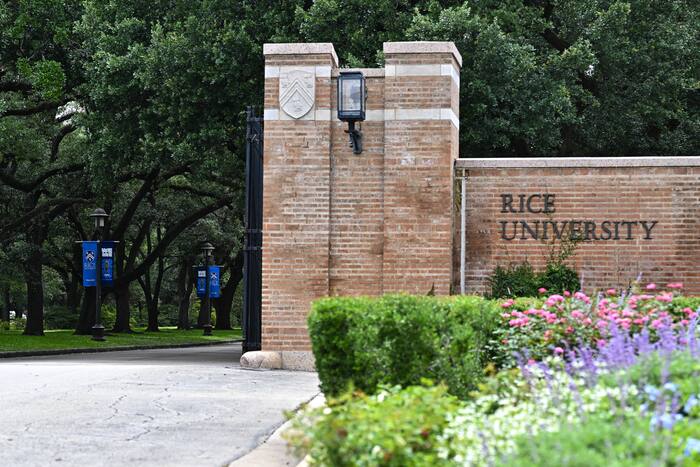
Houston’s Rice University is among 30 colleges and universities named in a federal civil rights complaint alleging a graduate recruitment program could be helping schools circumvent the U.S. Supreme Court’s ruling against race-based college admissions.
The complaint, filed Thursday, Nov. 12, with the U.S. Department of Justice’s Civil Rights Division, asks federal officials to investigate the Institute for Recruitment of Teachers (IRT) Consortium and whether participating universities provide preferential admissions consideration or financial benefits to students based on race.
The Equal Protection Project, a project of the Legal Insurrection Foundation, filed the complaint, arguing that the consortium could provide universities with a way to recruit students from a pool of applicants selected through a race-conscious program.
Rice is one of 30 institutions identified as a consortium member in the complaint.
Other universities named include Harvard, Yale, Princeton, Columbia, Cornell, Duke and Stanford.
The Institute for Recruitment of Teachers is an educational program affiliated with Phillips Academy Andover. Founded in 1990, the program was created to increase the number of minority students pursuing advanced degrees and careers in education.
Through the program, selected participants receive graduate admissions counseling, application preparation, mentorship and opportunities to connect with graduate school recruiters.
The consortium connects IRT participants with participating universities offering master’s and doctoral programs in fields including education, humanities, social sciences, arts, computer science and mathematics.
According to the complaint, participating universities also help recruit, admit and fund IRT participants.
IRT reports that 93% of its 2026 cohort identifies as people of color.
The complaint argues that universities participating in the consortium could be providing educational and financial advantages to students selected through IRT’s race-focused recruitment process.
Among the benefits identified are graduate application fee waivers, direct access to university admissions representatives and opportunities to pursue fellowships, scholarships and assistantships.
IRT advertises application fee waivers for approximately 10 to 12 graduate school applications, which the complaint estimates could save participants at least $1,000.
The organization argues that universities could be using IRT participation as a proxy for race when making graduate admissions or financial aid decisions.
However, the complaint does not identify a specific instance in which Rice University admitted or funded a student because of their race. It also does not establish that Rice violated federal law.
The Equal Protection Project is asking the DOJ to investigate all 30 participating institutions and examine their relationships with IRT.
Specifically, the organization wants federal officials to review university recruitment arrangements, admissions procedures, scholarship and fellowship eligibility requirements, application fee waivers and communications between IRT and university officials.
The complaint cites the Supreme Court’s 2023 decision in Students for Fair Admissions v. Harvard, which struck down race-conscious admissions programs at Harvard University and the University of North Carolina.
The organization argues that universities cannot accomplish indirectly through a third-party recruitment program what they would be prohibited from doing directly under the ruling.
The complaint alleges potential violations of Title VI of the Civil Rights Act of 1964, which prohibits intentional discrimination based on race, color or national origin by federally funded institutions. It also cites the Equal Protection Clause of the 14th Amendment, which applies to public universities.
The filing asks the DOJ to take enforcement action and require corrective measures if violations are established.
The complaint is a request for an investigation, not a finding of wrongdoing against Rice or the other universities named.


