
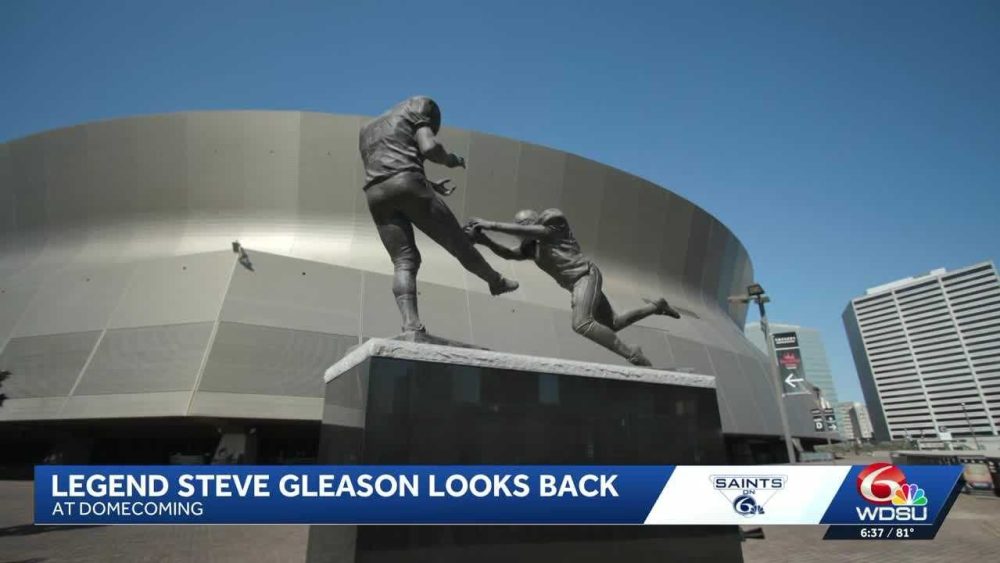
Twenty years after his iconic punt block during the New Orleans Saints’ “Domecoming” game, Steve Gleason reflects on the moment that became a symbol of hope for a city recovering from Hurricane Katrina.
Inside his lakefront home, Gleason, who is wheelchair-bound due to ALS, continues to fight the disease daily.
He has no movement in his arms or legs and uses his eyes and a computer to communicate.
“I know what it feels like to have your body taken away the ways you expect it to live,” Gleason said.
His wife, Michel, helps him manage the disease, even using tape to hold his eyelids open. She inscribed a special message, writing WDSU, for this interview.
“I was just a little white dude lucky enough to find the place on this team and in New Orleans,” Gleason said. “The people here welcomed me, celebrated with me, and when my life changed, stayed with me.”
The punt block, which occurred just minutes into the September 2006 game against the Atlanta Falcons, led to a Saints touchdown and is now memorialized outside the Superdome as “Rebirth.”
The play spurred the Saints to a decade of success and gave hope to fans still rebuilding their lives after Hurricane Katrina.
“That Monday night was about so much more than football,” Gleason said.
Reflecting on the time that has passed, Gleason said, “Twenty years? Yeah. You all may find this crazy, but given all I’ve been through, it feels more like twenty lifetimes. In some ways, I’ve already died to the life I thought I wanted and the life I thought I could control. And I’ve been reborn into a life of acceptance, gratitude, and miraculous beauty. When I blocked that punt, I could never have imagined the lives that would follow. ALS has changed my body, my plan, and my understanding of what it means to live. But I’m still here.”
Gleason acknowledged the significance of that moment for the city and its people.
“More than a scoreboard can measure,” he said. “People have endured so much loss. That night gave us somewhere to bring the grief, the fury, and the love all at once. I have lived through those thirteen months too. Even in the seconds after the block, I sensed this was bigger than a football play. The sound in the dome, the people around me. I felt like I was in every inch of the place.”
He added, “There was this incredible energy. People had chosen to come home and rebuild. I don’t think we were bringing New Orleans back—New Orleans had already determined it was coming back. We were fortunate to represent that spirit on the field and to the rest of the world. That’s what that moment means to me. We were part of something much bigger than football.”
Five years after the punt block, Gleason was diagnosed with ALS.
Since then, Team Gleason has raised more than $65 million over the past 15 years to raise awareness and search for a cure.
His efforts earned him the Congressional Gold Medal.
Gleason has also embraced fatherhood, raising two children, Rivers and Gray, with his wife, Michel.
“So much has changed,” Gleason said. “The man who blocked the punt could never have imagined this body or this life. My arms and legs are still. I cannot breathe, brother. I’m breathed. I have never hugged Rivers or Gray. That heartbreak is real for all of us. And so is the beauty. Michel, Rivers, Gray, our family, our friends, our caregivers, this city—they are my life.”
Reflecting on his journey, Gleason said;
“For me, it is a reminder that I am still here with them, still a father, still loving and being loved. I say this in my book, *A Life Impossible*, that if I don’t block that punt, I’d be dead. That moment connected my life to New Orleans in a way I never could have planned. When the ALS came, this community showed up for us. Twenty years later, I feel that love, and I’m grateful to be here for whatever comes next.”


